
Multi-Link Switching: Unlimited Scalability with Cost Efficiency
Quantum Key Distribution works between two nodes, as it is based on pairs of entangled photons. Due to the laws of physics, the entanglement cannot be extended to multiple nodes.
The usual approach for building larger QKD networks with multiple nodes is to use separate QKD systems for each connection between two nodes. While this works well, it can be costly. The ELVIS QKD system allows connecting one ELVIS Quantum Receivers with multiple other nodes via a beam splitter or an active optical switch. This Multi-Link Switching allows the user to:
- Reduce hardware costs as less receivers are required, or
- Use two or more redundant fibers for uninterrupted operation even if one fiber is damaged.
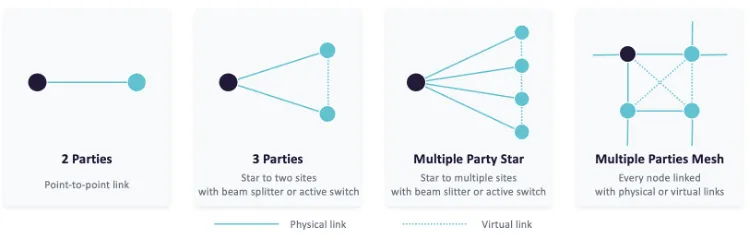
Naturally, in the first case the total key rate is shared among the connections to a single receiver. The unique ELVIS Enterprise advantage is that - aside from the slight attenuation introduced by the beam splitter or switch - this sharing incurs no additional penalty: ELVIS Enterprise has very brief resyncing delays when switching between nodes , so key rates remain high.
A single ELVIS fiber connection can be up to 100 km long . Longer distances can be covered using one or more trusted nodes in between - each of which must reside in the operator's secured environment - and can be either a full ELVIS Enterprise system or a Receiver equipped with a beam splitter or optical switch. A key management system can relay keys across these trusted nodes, creating virtual QKD connections spanning multiple intermediate nodes. This enables scaling to metro, national, and international QKD networks.
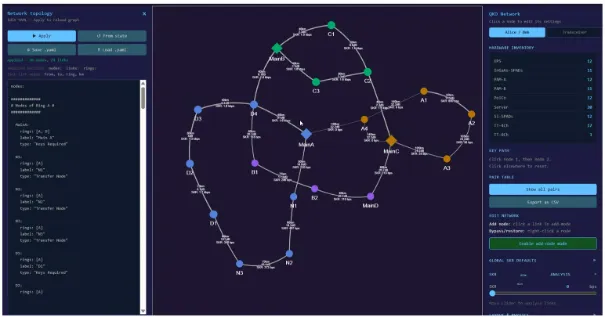
Quantum Optics Jena also supports its customers with tools for network planning and analysis.